Creatine: Every Question Answered
Published: May 28, 2026
Contains affiliate links — we earn a small commission if you buy through them, at no extra cost to you. We only recommend products we genuinely use.
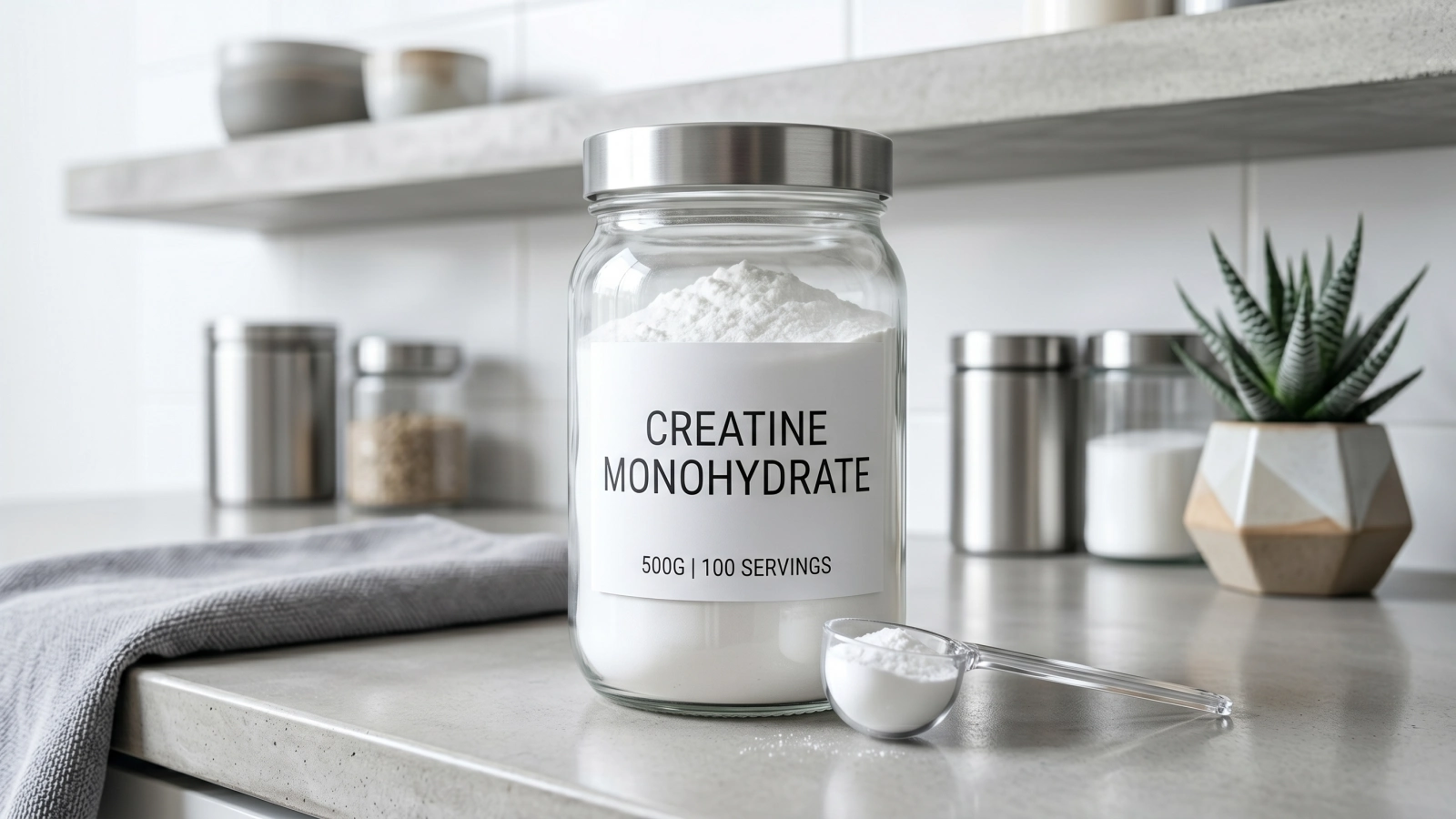
Product images were staged using AI for visual presentation purposes.
This article is for informational purposes only and is not a substitute for professional medical advice. Consult a healthcare provider before adding any new supplement to your routine.
At a glance
- Creatine is one of the most studied supplements ever; 30+ years of research support its safety and effectiveness
- It works by replenishing your muscles' energy supply faster during intense effort
- 3–5g per day of creatine monohydrate is the standard dose; no loading phase required
- Benefits include strength, lean muscle mass, faster recovery, and cognitive function
- The kidney concern applies only to people with pre-existing kidney disease, not healthy adults
When I was in high school, creatine had a reputation. It felt borderline scary, almost in the same category as steroids — something only the most extreme athletes took, probably in secret, probably with consequences nobody talked about. I steered clear of it entirely.
More than 30 years of research later, that picture looks very different. Creatine is among the most extensively studied supplements in existence, with a safety profile that most nutritionists and sports scientists describe as excellent. I take 5g every day. I’ve noticed real gains in lean muscle and meaningfully faster recovery after hard workouts. Nothing dramatic, nothing sudden, but consistent and real over time.
Here’s everything you actually need to know about it.
What Is Creatine?
Creatine is a compound your body makes naturally from amino acids, primarily in the liver and kidneys. It’s also found in food, mostly in red meat and fish. About 95% of the creatine in your body is stored in your muscles, where it plays a direct role in energy production during high-intensity exercise.
It is not a steroid. It has no hormonal activity. It is not a drug. Your body makes it, food contains it, and supplementing simply gives your muscles more of what they already use.
How Does Creatine Work?
Your muscles run on ATP (adenosine triphosphate), which is essentially cellular fuel. During explosive or intense effort, your muscles burn through ATP very quickly. The problem is that your body can only store a small amount of ATP at any given moment.
Creatine phosphate is what your muscles use to rapidly regenerate ATP. The more creatine phosphate you have stored, the faster your muscles can replenish their energy supply during bursts of intense effort. This translates directly to more reps, more power, more capacity before fatigue sets in.
Supplementing with creatine increases the total creatine phosphate stores in your muscles beyond what food and natural production provide. That extra reserve is what drives most of the performance benefits.
What Does the Research Actually Show?
Strength and Power Output
This is the most well-established benefit. Decades of research culminated in the ISSN’s comprehensive 2017 position stand, which concludes that creatine supplementation consistently improves performance in high-intensity, short-duration activities: weightlifting, sprinting, and any sport requiring repeated explosive efforts.
In practical terms: you can squeeze out more reps at a given weight, recover faster between sets, and sustain power output for longer before performance drops off.
Lean Muscle Mass
The strength gains translate to muscle gains over time. More capacity per training session means more stimulus for muscle growth. Research combining creatine with resistance training consistently shows greater gains in lean mass compared to training alone.
Some of this early-stage gain is from increased water retention inside muscle cells, which is not the same as bloating (more on this below). Over weeks and months, actual muscle fiber development accounts for the rest.
Recovery
Creatine appears to reduce muscle cell damage and inflammation following intense exercise, which shortens recovery time. This matters most for people training frequently. If you lift four or five times per week, faster recovery between sessions is a meaningful compounding advantage over time.
Cognitive Function and Brain Health
This one surprises most people. Creatine isn’t just a muscle supplement.
Your brain uses creatine the same way your muscles do, to maintain energy availability during demanding cognitive work. A 2023 meta-analysis of 10 randomized controlled trials found that creatine supplementation significantly improved memory performance, with the largest effects in older adults. A 2018 systematic review found improvements in short-term memory and reasoning. Earlier research, including a double-blind placebo-controlled trial from 2003, found meaningful improvements in working memory and intelligence tasks.
The brain benefits appear to be strongest in people who are sleep-deprived, vegetarian or vegan (who get very little creatine from food), or older. But the effect shows up in healthy young adults too.
Older Adults
Creatine becomes more valuable with age. Muscle mass declines naturally after your mid-30s, and the rate accelerates significantly after 60. Creatine helps counteract this. A 2026 systematic review and meta-analysis found that creatine combined with resistance training produced meaningful improvements in lean mass and strength in postmenopausal women, with no serious adverse events. Similar benefits have been found across older adult populations generally.
Who Should Take Creatine?
People who do any form of strength training or high-intensity exercise. This is the primary use case and where the evidence is strongest. More energy capacity during training means more productive sessions.
Older adults. Preserving muscle mass and strength with age is one of the most important things you can do for long-term health and independence. Creatine makes that easier.
Vegetarians and vegans. Dietary creatine comes almost entirely from meat and fish. People who don’t eat these foods have significantly lower baseline creatine stores, which means the benefit from supplementing is often more pronounced.
People who want cognitive support. The brain benefits are real, especially for those doing mentally demanding work, managing sleep deprivation, or looking for an edge on focus and memory.
People on GLP-1 medications. If appetite suppression is reducing how much you eat, you’re likely getting less creatine from food. Supplementing maintains muscle-preserving creatine levels when total food intake is lower. See our guide on protein tracking on GLP-1 for more on keeping muscle while eating less.
Who Probably Doesn’t Need It
Casual exercisers doing light activity a couple of times a week will see minimal benefit. Creatine works by extending capacity during intense effort; if your workouts rarely push you to that threshold, the extra creatine stores won’t be meaningfully used.
How Much Should You Take?
3–5g per day. This is the well-established maintenance dose and what the ISSN position stand recommends. It’s enough to saturate muscle creatine stores over several weeks and maintain saturation with ongoing daily use.
I take 5g daily, which is the most common dose in the research.
Do You Need to Do a Loading Phase?
No. A loading phase (20g per day for 5–7 days, split into four doses) saturates your muscle stores faster, typically within a week rather than three to four weeks. But you reach the same endpoint either way.
Loading makes sense if you want results quickly, such as before a competition or for a specific short training block. For long-term supplementation, there is no meaningful reason to load. Just start with 3–5g daily and let your stores build over a few weeks.
If you do load, take the 20g in four separate 5g doses throughout the day rather than all at once, which reduces the chance of GI discomfort.
When Should You Take It?
Timing matters less than consistency. The research on pre-workout vs. post-workout creatine dosing shows small and inconsistent differences. What matters most is taking it every day so your muscle stores remain saturated.
The most practical approach is to attach it to something you already do daily: mix it into your morning protein shake, your post-workout drink, or even a glass of juice at breakfast. Creatine monohydrate is odorless and virtually tasteless.
What Type of Creatine Is Best?
Creatine monohydrate. This is the form used in essentially all of the research, it is the cheapest, and no other form has been shown to be meaningfully superior.
The supplement industry has produced numerous alternatives: creatine HCl, buffered creatine (Kre-Alkalyn), creatine ethyl ester, liquid creatine. These are priced higher and marketed with claims of better absorption or fewer side effects. The ISSN position stand concludes that none of these alternatives outperforms monohydrate in research.
If you see a fancy form marketed at three times the price, you’re paying for the marketing.
One quality marker worth knowing: Creapure is a certified form of creatine monohydrate manufactured in Germany with stringent purity standards. Many reputable brands use it. It is not inherently better than other high-quality monohydrate, but it’s a reliable signal that the product is what the label says it is.
What I use: Naked Creatine. Single ingredient, Creapure-sourced, no fillers or flavoring. Mixes cleanly into anything and is significantly cheaper per gram than branded alternatives.
Does Creatine Cause Water Retention?
Yes, but not in the way most people fear. Creatine draws water into muscle cells, not subcutaneously (under the skin). This means muscles appear slightly fuller, not puffier. It is intracellular water, which is part of what makes muscles look more defined, not less.
Most people gain 1–2 kg in the first week of creatine use from this effect. This is not fat. It’s also not the kind of bloating associated with excess sodium or poor diet. If you stop taking creatine, this water leaves within a couple of weeks.
Is Creatine Safe?
Yes, for healthy adults. The concern about kidney damage has been studied extensively and has not been supported in healthy populations. The ISSN’s 2017 review of the safety literature concludes that creatine supplementation at recommended doses does not harm kidney function in people without pre-existing kidney disease.
The kidney concern originated from case reports involving people who already had compromised kidney function. If you have a history of kidney disease, kidney stones, or reduced kidney function, talk to your doctor before supplementing. For healthy adults, the body of research is reassuring.
Creatine has been studied in adults, adolescents, and elderly populations. The safety record across all of these groups is strong.
Does Creatine Cause Hair Loss?
This question comes from one study published in 2009, which found that three weeks of creatine supplementation raised the ratio of DHT (dihydrotestosterone) to testosterone in college-aged rugby players. DHT is associated with androgenic hair loss in people who are genetically predisposed to it.
A few important caveats:
- This is one study, with a small sample, and it has not been replicated.
- The study did not measure hair loss. It measured DHT levels, and the DHT levels stayed within the normal range throughout.
- There is no clinical evidence linking creatine supplementation directly to hair loss in humans.
If you have a strong family history of male-pattern baldness and the question worries you, that concern isn’t unreasonable given the single study. But the evidence is not strong enough to say creatine causes hair loss.
Does Creatine Need to Be Cycled?
No. There is no research supporting the practice of cycling creatine (taking it for a period and then stopping). Some older bodybuilding advice recommended this, but it has no scientific basis. Your body does not become “dependent” on creatine in any meaningful sense, and stopping and restarting simply means waiting for stores to build back up.
Take it daily, year-round, if you want consistent benefit.
Can Women Take Creatine?
Yes, and the research is increasingly clear that women benefit from it. The 2026 meta-analysis of postmenopausal women found improvements in lean mass and strength. Research in younger women shows similar performance and recovery benefits to those seen in men.
Women generally have lower baseline muscle creatine stores than men, which means supplementation may have a proportionally larger effect. The concerns about bulk or looking too muscular are unfounded; creatine does not cause a hormonal response that drives dramatic muscle growth.
What About Creatine for Vegetarians and Vegans?
Vegetarians and vegans tend to have lower baseline muscle creatine stores because they get none from food. Research consistently shows that this population sees a larger response to creatine supplementation compared to meat-eaters, in both physical performance and cognitive outcomes.
If you don’t eat meat or fish, creatine is arguably one of the highest-value supplements you can take.
Does Caffeine Cancel Out Creatine?
Early research suggested caffeine might blunt creatine’s ergogenic effect, but more recent and better-designed studies have not confirmed this interaction. The ISSN position stand does not identify caffeine as a meaningful concern.
I drink a lot of coffee and take creatine every day. I notice the benefits. If this interaction were real and significant, I’d be a good test case for it, and I’m not seeing it. Most heavy coffee drinkers report the same experience.
Track Your Nutrition with Free Calorie Track
Creatine works best as part of a diet that supports your training goals: adequate protein to build muscle, enough calories to fuel recovery, and tracked macros so you know where you actually stand.
Free Calorie Track tracks protein, calories, carbs, fat, and fiber simultaneously for every food you log, in real time. If you’re trying to build muscle or preserve it through a deficit, see our guide on protein supplements and how to hit both your protein and fiber targets.
👉 Start tracking free → — no account required
Related Articles
Protein Supplements: Who Needs Them
Types, timing, and how much you actually need
How to Get Enough Protein and Fiber
Hit both targets simultaneously without going crazy
High Protein Low Calorie Foods
Complete list with macros per 100g
Protein Tracking on GLP-1
Why protein matters most on Ozempic and Wegovy