What is Protein? Complete Guide + Calculator
Published: March 2, 2026
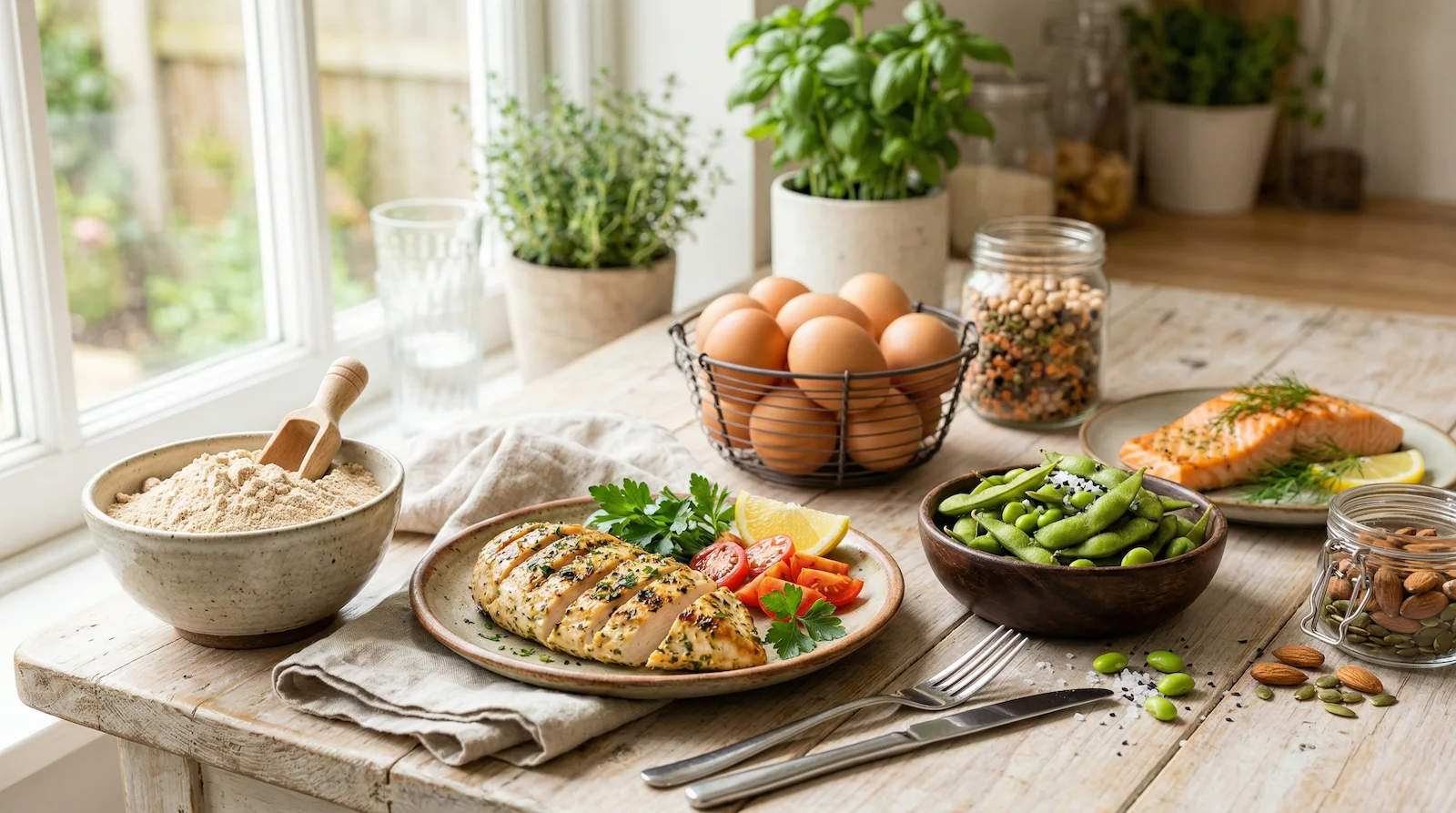
At a glance
- Protein is one of three macronutrients (protein, carbs, fat) your body needs to function
- It builds and repairs muscle, produces enzymes and hormones, and keeps you full
- Most active people need 0.7-1g protein per lb body weight daily
- Best sources: chicken, fish, eggs, Greek yogurt, legumes, tofu
Protein is the most talked-about macronutrient in fitness and nutrition—and for good reason. Whether you’re trying to lose fat, build muscle, or just stay healthy, getting enough protein is critical.
Here’s everything you need to know about protein, from the science to practical food sources.
What is Protein?
Protein is one of the three macronutrients your body needs in large amounts (along with carbohydrates and fat). It’s made up of building blocks called amino acids, which your body uses to build and repair tissues.
Think of protein as the raw material for:
- Muscle tissue - Building and repairing muscle fibers
- Enzymes - Facilitating chemical reactions in your body
- Hormones - Regulating processes like metabolism and mood
- Antibodies - Supporting immune function
- Skin, hair, and nails - Structural proteins like collagen and keratin
Fun fact: The word “protein” comes from the Greek word proteios, meaning “primary” or “of first importance.”
The 20 Amino Acids
Proteins are made from 20 different amino acids. Your body can produce some, but 9 are essential—you must get them from food.
Essential Amino Acids (Must Get from Food)
- Histidine
- Isoleucine (BCAA)
- Leucine (BCAA)
- Lysine
- Methionine
- Phenylalanine
- Threonine
- Tryptophan
- Valine (BCAA)
Non-Essential Amino Acids (Body Makes These)
Your body can synthesize the other 11 amino acids from the essential ones or other compounds.
Complete vs. Incomplete Proteins
Complete proteins contain all 9 essential amino acids in sufficient amounts:
- Animal sources: meat, poultry, fish, eggs, dairy
- Plant sources: soy (tofu, edamame), quinoa, buckwheat
Incomplete proteins lack one or more essential amino acids:
- Most plant sources: beans, lentils, nuts, seeds, grains
Good news: You don’t need complete proteins at every meal. Eating a variety of plant proteins throughout the day provides all essential amino acids (called “complementary proteins”).
Why Protein Matters
1. Builds and Repairs Muscle
When you work out, you create micro-tears in muscle fibers. Protein provides the amino acids needed to repair and grow those fibers stronger.
Without enough protein:
- Muscle recovery slows
- Strength gains stall
- You’re more prone to injury
With adequate protein:
- Faster recovery
- Better muscle growth (hypertrophy)
- Improved strength and performance
2. Keeps You Full (Satiety)
Protein is the most satiating macronutrient. It reduces hunger hormones (ghrelin) and increases fullness hormones (peptide YY, GLP-1).
Studies show: High-protein diets significantly reduce cravings and late-night snacking.
Why it works:
- Protein digests slowly
- Stabilizes blood sugar (no crashes)
- Reduces appetite naturally
For weight loss: Eating more protein helps you eat fewer calories without feeling deprived.
3. Burns More Calories (Thermic Effect)
Digesting protein burns more calories than digesting carbs or fat. This is called the thermic effect of food (TEF).
TEF by macronutrient:
- Protein: 20-30% (you burn 20-30 calories digesting 100 calories of protein)
- Carbs: 5-10%
- Fat: 0-3%
Example: If you eat 2,000 calories with 30% protein (600 cal), you burn ~150 calories just digesting it.
4. Preserves Muscle During Fat Loss
When you eat in a calorie deficit to lose weight, your body can break down muscle for energy. Protein (plus strength training) signals your body to preserve muscle and burn fat instead.
Research shows: High protein intake (0.7-1g per lb) during a deficit helps maintain lean mass while losing fat.
5. Supports Metabolic Health
Protein plays a role in:
- Blood sugar control - Slows glucose absorption
- Bone health - Provides structure and minerals
- Immune function - Antibodies are proteins
- Wound healing - Tissue repair requires amino acids
How Much Protein Do You Need?
The “right” amount depends on your goals, activity level, and body composition.
General Guidelines (Per Pound of Body Weight)
| Goal | Protein Intake |
|---|---|
| Sedentary / Minimum (RDA) | 0.36-0.5g per lb |
| Active / General Fitness | 0.6-0.8g per lb |
| Building Muscle | 0.8-1g per lb |
| Fat Loss (preserve muscle) | 0.8-1.2g per lb |
| Athletes / High Activity | 0.7-1g per lb |
Examples
150 lb person losing fat:
- 0.8g × 150 lb = 120g protein/day (minimum)
- 1g × 150 lb = 150g protein/day (optimal)
180 lb person building muscle:
- 0.8g × 180 lb = 144g protein/day (minimum)
- 1g × 180 lb = 180g protein/day (optimal)
Calculate Your Protein Needs
Use the calculator below to find your personalized protein target. Free Calorie Track automatically calculates your protein goal based on your stats and goals—no manual math required.
Protein Calculator
Best Protein Sources
Animal-Based (Complete Proteins)
| Food | Serving | Protein | Calories |
|---|---|---|---|
| Chicken breast | 4 oz (113g) | 35g | 187 |
| Turkey breast | 4 oz (113g) | 30g | 153 |
| White fish (cod, tilapia) | 4 oz (113g) | 23g | 110 |
| Salmon | 4 oz (113g) | 25g | 180 |
| Tuna (canned in water) | 1 can (142g) | 26g | 120 |
| Shrimp | 4 oz (113g) | 23g | 120 |
| Eggs (whole) | 2 large | 13g | 143 |
| Egg whites | 1 cup | 26g | 125 |
| Greek yogurt (non-fat) | 1 cup | 24g | 130 |
| Cottage cheese (low-fat) | 1 cup | 28g | 160 |
| Lean ground beef (95/5) | 4 oz cooked | 24g | 155 |
Plant-Based
| Food | Serving | Protein | Calories | Complete? |
|---|---|---|---|---|
| Tofu (extra firm) | 4 oz (113g) | 10g | 90 | ✅ Yes |
| Edamame | 1 cup shelled | 18g | 188 | ✅ Yes |
| Tempeh | 3 oz (85g) | 16g | 140 | ✅ Yes |
| Seitan | 3 oz (85g) | 21g | 120 | ✅ Yes |
| Lentils | 1 cup cooked | 18g | 230 | ❌ No |
| Black beans | 1 cup cooked | 15g | 227 | ❌ No |
| Chickpeas | 1 cup cooked | 15g | 269 | ❌ No |
| Quinoa | 1 cup cooked | 8g | 222 | ✅ Yes |
Protein Supplements
| Type | Serving | Protein | Calories |
|---|---|---|---|
| Whey isolate | 1 scoop (30g) | 25g | 110 |
| Whey concentrate | 1 scoop (30g) | 24g | 130 |
| Casein | 1 scoop (30g) | 24g | 120 |
| Plant-based blend | 1 scoop (30g) | 20g | 120 |
👉 See the full list of high protein low calorie foods
When to Eat Protein
Does Timing Matter?
For most people: No. Total daily protein intake matters far more than timing.
However, timing CAN help with:
1. Post-Workout (The “Anabolic Window”)
Old belief: You have a 30-minute window after training to consume protein, or you’ll lose gains.
Reality: The “window” is more like 4-6 hours. As long as you eat protein sometime around your workout (before or after), you’re fine.
Recommendation: Eat 20-40g protein within a few hours post-workout for optimal recovery.
2. Spreading Protein Throughout the Day
Why it helps: Your body can only use ~20-40g of protein at once for muscle protein synthesis. Eating more in one sitting doesn’t provide additional muscle-building benefits.
Best practice: Aim for 20-40g protein per meal, spread across 3-4 meals.
Example for 150g daily target:
- Breakfast: 30g
- Lunch: 40g
- Dinner: 50g
- Snack: 30g
3. Before Bed (Casein)
Casein protein (found in cottage cheese and casein powder) digests slowly, providing a steady release of amino acids overnight. This can help with muscle recovery during sleep.
Not essential, but helpful if you struggle to hit your protein target during the day.
Can You Eat Too Much Protein?
Disclaimer: This information is for general educational purposes only. If you have kidney disease, liver disease, or other medical conditions, consult your healthcare provider before significantly increasing protein intake.
For healthy people: Probably not.
Upper limits:
- Most research shows no harm up to 1.5g per lb body weight
- Even higher intakes (2g+ per lb) appear safe for healthy individuals
- Your body simply converts excess protein to energy or excretes it
Exceptions (consult a doctor):
- Kidney disease (high protein can worsen it)
- Certain metabolic disorders
Practical concern: Eating excessive protein leaves less room for carbs and fats, which you also need for health and performance.
Bottom line: For most people, 0.7-1.2g per lb body weight is optimal. Going higher won’t hurt, but it won’t provide additional benefits either.
Protein Myths Debunked
Myth 1: “You can only absorb 30g of protein per meal”
Truth: Your body CAN absorb more than 30g per meal. The 30g figure refers to muscle protein synthesis—eating 50g in one meal won’t waste the extra 20g, it just won’t maximize muscle growth beyond the same threshold.
Myth 2: “Plant protein is inferior to animal protein”
Truth: While most plant proteins are incomplete, eating a variety of plant foods provides all essential amino acids. Plant-based athletes and bodybuilders thrive with proper planning.
Myth 3: “You need protein immediately after working out”
Truth: The “anabolic window” is overhyped. As long as you eat protein within several hours of training, you’re fine.
Myth 4: “Protein powder is necessary”
Truth: Protein powder is convenient, not required. You can hit your targets with whole foods alone. Supplements are just that—supplemental.
Protein and Weight Loss
Why Protein is Essential for Fat Loss
- Increases satiety - You feel fuller on fewer calories
- Preserves muscle - Prevents metabolic slowdown
- Burns more calories - High thermic effect (TEF)
- Reduces cravings - Stabilizes blood sugar
Research consistently shows: High-protein diets (25-30% of calories) result in more fat loss and better muscle retention compared to low-protein diets, even at the same calorie intake.
Protein and Muscle Building
How Protein Builds Muscle
Muscle protein synthesis (MPS) is the process of repairing and building muscle fibers. Resistance training triggers MPS, and protein provides the building blocks.
Requirements for muscle growth:
- Progressive overload (lifting heavier over time)
- Adequate protein (0.8-1g per lb)
- Calorie surplus or maintenance (hard to build muscle in a deficit)
- Recovery (sleep and rest days)
Do You Need More Protein to Build Muscle?
Research shows: 0.7-1g per lb is sufficient for muscle growth. Going higher (1.2-1.5g) doesn’t increase gains but can help with satiety and recovery.
Exception: Natural bodybuilders in a lean bulking phase sometimes go higher (1-1.2g per lb) to maximize gains, but the additional benefit is small.
How to Hit Your Protein Target
1. Prioritize Protein at Every Meal
Don’t save all your protein for dinner. Spread it across meals.
Breakfast ideas:
- Eggs or egg whites
- Greek yogurt
- Protein pancakes
- Protein smoothie
Lunch/Dinner ideas:
- Grilled chicken or fish
- Ground turkey or lean beef
- Tofu or tempeh
- Beans or lentils with grains
2. Snack on High-Protein Foods
- Protein shake
- Cottage cheese
- Beef or turkey jerky
- Hard-boiled eggs
- Greek yogurt
3. Use Protein Powder Strategically
- Post-workout shake
- Added to oatmeal
- Blended into smoothies
- Mixed into Greek yogurt
4. Meal Prep Protein in Bulk
Cook 3-4 lbs of chicken, ground turkey, or tofu on Sunday. Divide into containers. Now you have ready-to-eat protein all week.
5. Track Your Intake
Use Free Calorie Track to log your food and monitor protein intake. You can’t manage what you don’t measure.
Protein FAQ
What if I’m vegetarian or vegan?
Focus on complete plant proteins (soy, quinoa, buckwheat) and combine incomplete proteins throughout the day. Consider plant-based protein powder to help hit your target.
Is protein powder safe?
Yes, for most people. Whey and casein come from milk; plant-based powders come from peas, rice, or hemp. Choose reputable brands with third-party testing (NSF, Informed Sport).
Can kids/teens eat high protein?
Yes, active kids and teens can benefit from higher protein (0.5-0.8g per lb), especially during growth spurts and if they play sports.
What’s the difference between whey and casein?
- Whey: Fast-digesting, ideal post-workout
- Casein: Slow-digesting, good before bed or between meals
Both are effective—choose based on timing preference.
Track Your Protein with Free Calorie Track
Free Calorie Track makes hitting your protein goals easy:
- ✅ Track protein, carbs, and fat for every food
- ✅ Barcode scanner for packaged protein sources
- ✅ Thousands of foods with accurate macro data
- ✅ Set custom protein targets
- ✅ 100% free